Real-estate operations
Smart Property Operations
Maintenance, vendor dispatch, and unit history for mid-size property managers — automated where safe, audited everywhere.
Who it serves
Mid-size property managers — a few hundred to a few thousand units — live in the gap between spreadsheets and enterprise platforms built for REITs. A three-person office juggles tenant calls, vendor availability, owner reporting, and legal exposure, and the operational memory of the portfolio lives in one coordinator’s inbox. When that person leaves, the portfolio forgets itself.
The problem, concretely
- Maintenance requests arrive by phone, email, and text — untriaged and untracked
- Dispatching a vendor means three calls and no record of why that vendor, at that price
- Unit history is scattered; the fourth leak in the same bathroom looks like the first
- Owners ask “what did we spend on that building and why” and the answer takes a day
- Disputes with tenants or vendors come down to whoever kept better notes
Product approach
- One intake, structured. Tenants report issues through a guided flow (or the office logs a call into the same form): category, urgency, photos, access permissions. Unstructured channels get transcribed into the same schema, flagged as transcriptions.
- Automation moves work; people commit it. Rules can propose a vendor, draft a work order, and schedule around tenant availability. Anything that spends money or enters a home requires a named person’s approval — one tap, but a real one.
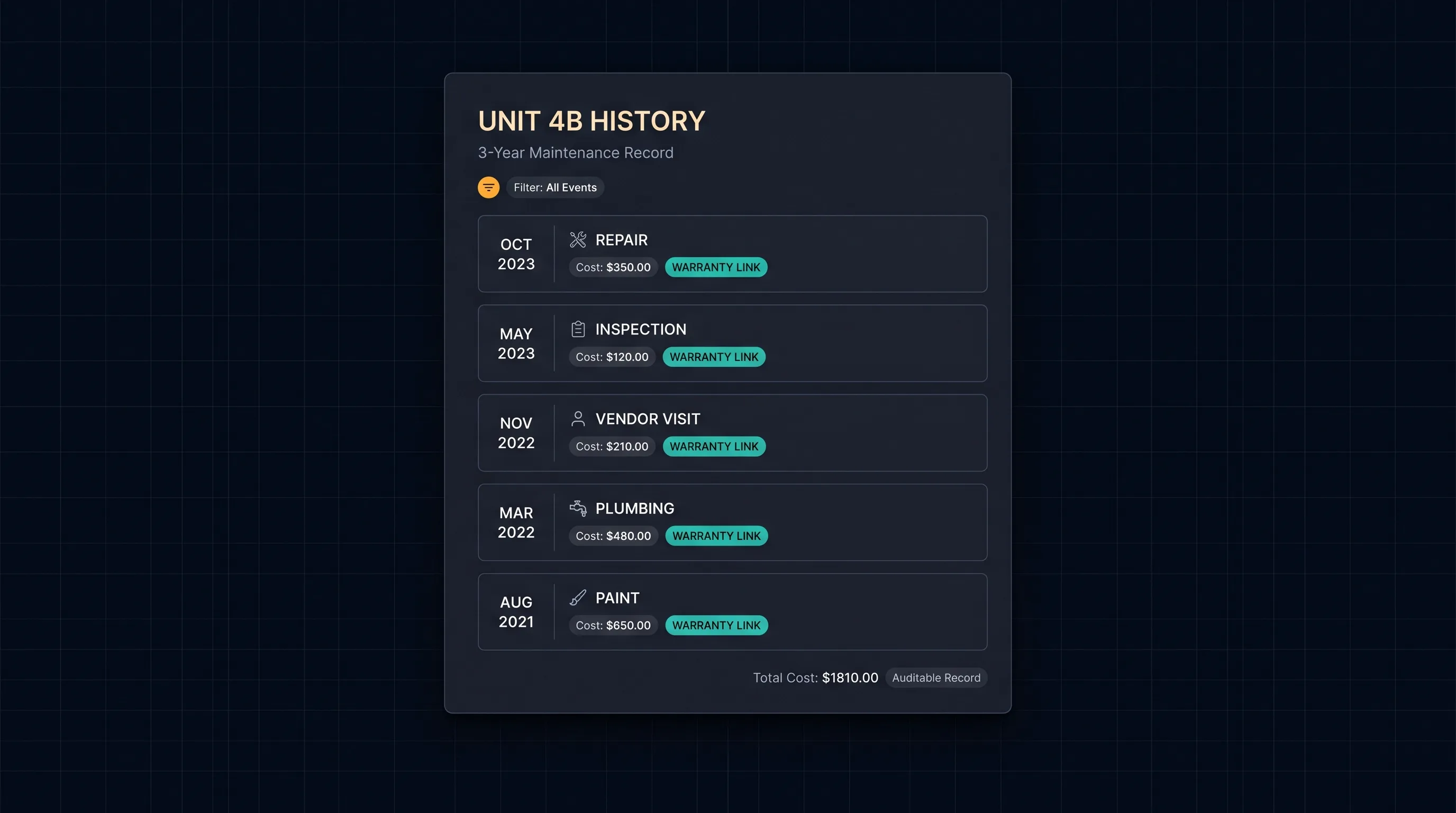
- The unit is the unit of memory. Every request, visit, invoice, and message attaches to the unit’s permanent record. History is the product; the workflow is how it gets written.
- Audit trail by construction. Every state change records who or what caused it — including rules. “Auto-dispatched by rule 12, approved by M. Tamm” is a first-class fact, queryable later.
The core loop
- Tenant reports issue guided intake, photos, access window
- Triage category, urgency, unit history attached
- Dispatch proposed vendor, rate, schedule drafted by rules
- Manager approves named sign-off before money moves
- Vendor completes photos and invoice against the work order
- Close-out tenant confirms; everything lands in unit history
Tenant communication that doesn’t pretend
Status updates are automated and say so. Messages are signed “Automated update from [Office name]” — no fake first names, no chatbot performing empathy about a broken boiler. The design bet is that tenants prefer a fast, honest robot with a visible escalation path (“reply URGENT to reach a person”) over a slow simulation of a human. When a person does reply, that’s visible too. Trust in the channel is worth more than the illusion of staffing.
Where automation must stop
Vendor selection rules can encode preference and price caps, but edge cases — emergency pricing, a tenant with a conflict history, work above a threshold — route to a person by design, not by exception handling. The system is deliberately conservative about legal artifacts: notices, deposit deductions, and anything lease-adjacent are templates a human fills and sends, never auto-generated text.
Data and permissioning
Unit histories contain personal life by implication — who lives where, when they’re home, what broke and when. Access is role-scoped (owner, manager, coordinator, vendor), vendors see only their own work orders, and owner reporting aggregates without exposing tenant communications. Data residency and retention follow the strictest market the portfolio operates in.
Prototype scope
One portfolio shape (residential, single office), intake plus dispatch plus unit history, and a mobile companion limited to what vendors and coordinators need in the field: the work order, the photos, the sign-off. Owner reporting and accounting integrations wait until the loop proves itself.
Evaluation plan
- Intake coverage: share of requests entering through the structured flow rather than around it — the honest adoption metric
- Time from report to approved dispatch, against a same-day design budget for urgent categories
- Approval friction: do managers rubber-stamp rule proposals, or meaningfully reject some? A 0% rejection rate means the approval step is theater
- History payoff: how often does attached unit history change a triage decision?
Risks and open questions
- Vendor adoption is the weak link — a companion app vendors won’t open pushes coordination back to the phone
- Rules encode a portfolio’s judgment; migrating that judgment out of a coordinator’s head is consulting work disguised as onboarding
- The honest-automation stance in tenant messaging is a bet, not a certainty; it needs testing against the charitable reading of the alternative