Logistics & sustainability
Carbon-Aware Delivery Planner
Route and load planning that prices emissions next to hours and euros — and shows planners exactly why each route won.
The premise
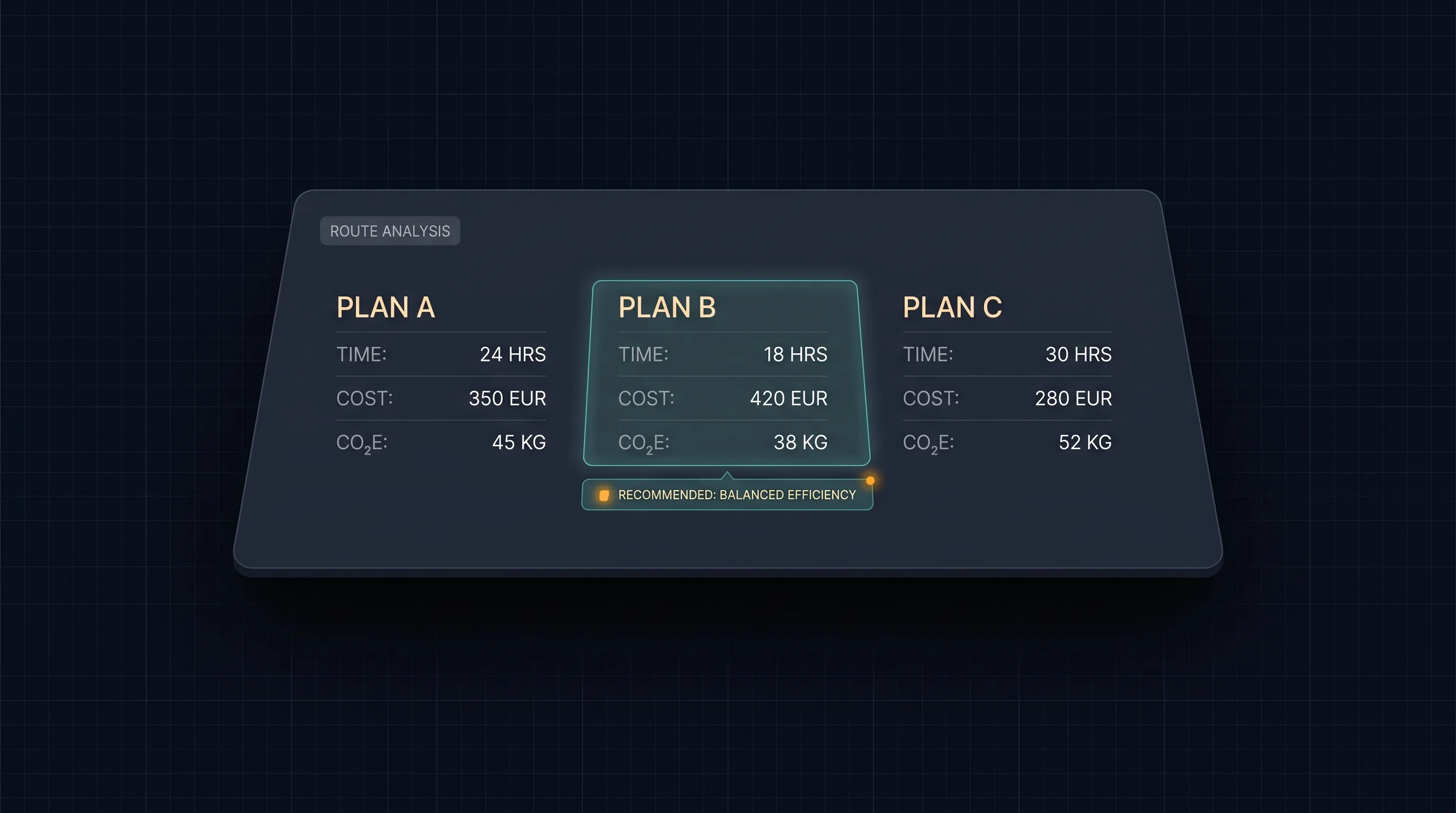
Most logistics software treats emissions as reporting: routes are planned on time and cost, and a sustainability number is computed afterwards for the annual PDF. This concept moves emissions upstream — into the objective function — so a dispatcher planning tomorrow’s deliveries sees three currencies on every candidate plan: hours, euros, and kilograms of CO₂e. Sometimes the greenest plan is also the cheapest (consolidation usually is). When it isn’t, the trade-off should be a visible, priced decision rather than an invisible default.
Optimization you can argue with
Planners override tools they don’t understand, and they are right to. Every plan the optimizer proposes comes with its reasoning exposed: which constraints bound it, what the next-best alternative was, and what each trade-off costs in the other two currencies (“this variant saves 41 kg CO₂e for 22 extra minutes and one additional stop”). The planner remains the decision-maker; the system records which plan was chosen and why, so the choices themselves become auditable data.
- Orders land deliveries, windows, vehicle constraints
- Candidate plans generated scored on time, cost, CO₂e
- Planner compares trade-offs explicit, next-best shown
- Routes dispatched chosen plan and rationale recorded
- Actuals return fuel and telematics correct the estimates
The honest problem: emission factors
Emissions math is only as good as its factors, and public factors are averages with wide error bars — a “diesel van, urban” coefficient can miss a specific vehicle’s reality badly. The concept refuses to hide this. Every CO₂e figure carries a data-grade label: modeled from public factors, refined from the fleet’s fuel records, or measured from telematics. Plans are compared within the same grade, and the interface shows ranges, not four-significant-digit precision that the underlying data cannot support. As fuel-card and telematics data accumulates, factors are recalibrated per vehicle — which is where the numbers start deserving trust.
Where AI fits
The optimizer itself is classical operations research — vehicle routing is a solved class of problem and doesn’t need a language model. AI earns its place at the edges: parsing messy order data into structured constraints, explaining a plan’s trade-offs in the planner’s language, and flagging anomalies between predicted and actual consumption that suggest a factor is wrong. Nothing generative sits between the solver and the dispatch decision.
Prototype scope
One depot, one day-ahead planning horizon, a fleet described in a spreadsheet, and public emission factors with the grading system in place from day one. Integrations with telematics come second; the first question is behavioral.
Evaluation plan
- Do planners consult the emissions column, or collapse it? (Interaction telemetry on the trade-off view)
- Override rate with reasons — target hypothesis: overrides fall as explanation quality improves, not as the optimizer gets pushier
- Factor drift: gap between modeled and fuel-record CO₂e per vehicle, tracked as the calibration loop runs
- The commercial question, tested in interviews: will an operations manager pay for emissions as a planning input, or only as a reporting output?