Consumer health
Personal Energy Coach
Gentle energy forecasts from sleep, activity, and how you say you feel — insights you can ignore safely, with no medical claims attached.
The wellness-app problem
Most energy and recovery apps overreach. They take noisy sensor data, run it through an opaque score, and deliver verdicts with medical confidence: your body battery is 23%, today is a rest day. Users either obey a number nobody can audit or churn out when the verdicts contradict lived experience. This concept starts from the opposite position: the data is weak, the science is correlational, and the product should say so.
A forecast, not a verdict
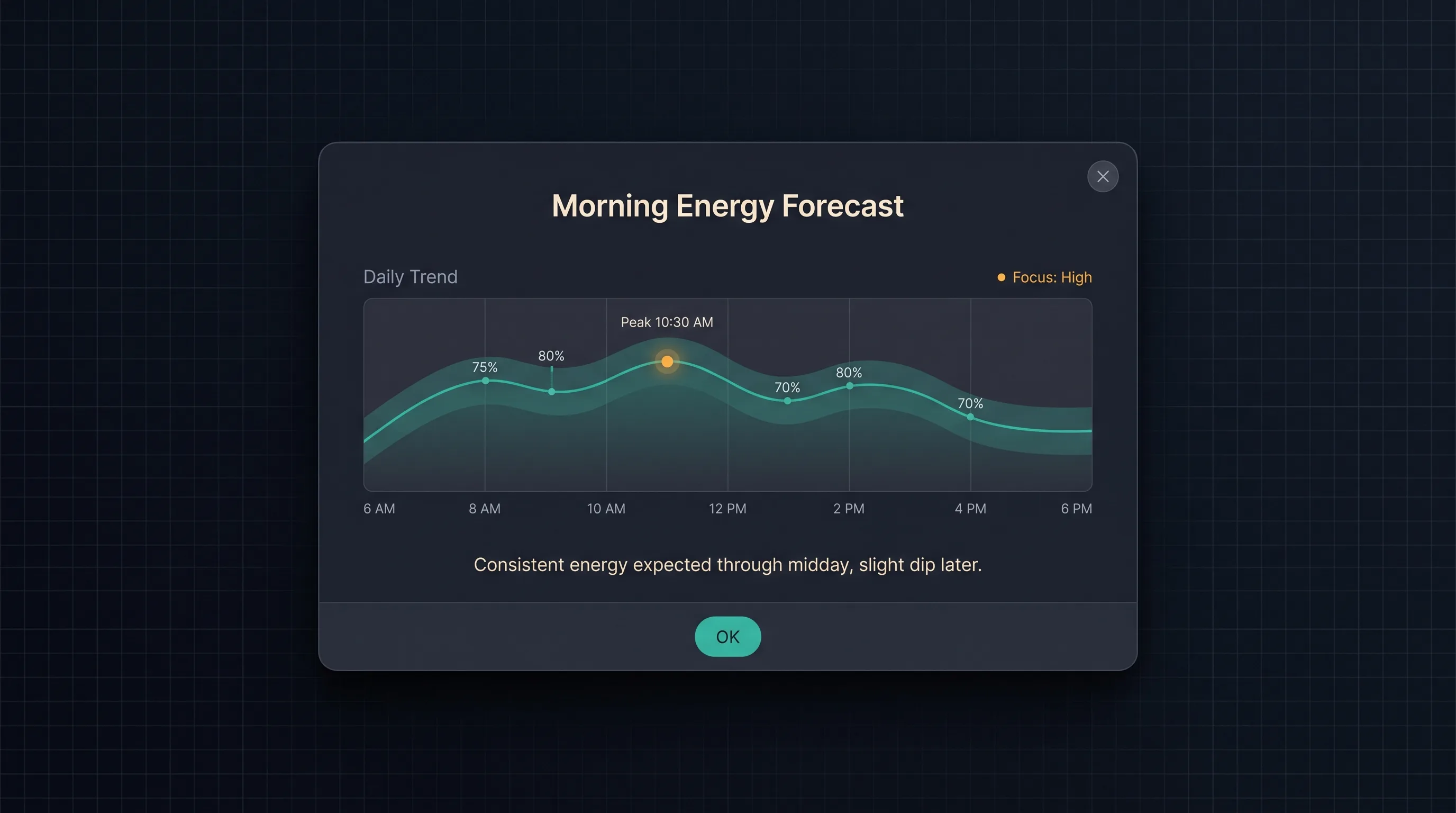
The core object is a daily energy forecast — a morning estimate of when you’re likely to feel sharp, flat, or fading, expressed the way a weather app expresses rain: as a probability band, not a command. Sleep duration and regularity, recent activity load, and a ten-second self-report (“how do you actually feel?”) feed the model. When the inputs disagree — the sensors say rested, you say wrecked — the self-report wins, and the forecast widens its band rather than picking a side.
Insights you can ignore safely
Every suggestion is designed to be droppable without penalty. No streaks, no guilt mechanics, no “you missed your recovery window” notifications. A suggestion appears at most once a day, states its evidence in one line (“your last three short-sleep days preceded low-energy afternoons”), and admits its sample size. If the user ignores a class of suggestion three times, it stops appearing. The hypothesis: an assistant that never nags earns the right to be heard when it does speak.
Where the AI stops
Pattern-finding across a person’s own history is the legitimate job: surfacing correlations between sleep timing, activity, and self-reported energy that the user can inspect and dismiss. Firmly out of scope: diagnoses, health-risk language, supplement or treatment suggestions, and any claim that crosses from “you tend to” into “you should because your body.” The copy is reviewed against a fixed rule — every statement must survive the prefix “in your own logged data…”. Anything that can’t is cut.
Data boundaries
Energy, sleep, and mood history is intimate by accumulation. The concept keeps raw sensor data and self-reports on device, computes forecasts locally, and syncs only an encrypted backup the user controls. There is no social layer, no sharing default, and no advertising surface — the honest business model for this category is a subscription, or nothing.
Prototype scope and evaluation
A prototype needs one platform, HealthKit or Health Connect ingestion, the self-report prompt, and the forecast view — no coaching content library. Evaluation targets are framed as hypotheses:
- Forecast usefulness: do users rate the morning band as “roughly right” on more than half of days after two weeks of calibration?
- Trust behavior: does the widened-uncertainty state reduce reported annoyance compared with a fixed confident score?
- Ignorability: does suppressing dismissed suggestion types measurably reduce churn versus a control that keeps suggesting?
Open questions
Whether a deliberately modest product can compete for attention against apps that promise more than the data supports is itself the experiment. If restraint reads as weakness rather than honesty, the concept fails on positioning, not engineering — and that is worth knowing before anything bigger is built.