Logistics
Logistics Exception Manager
An exception queue with resolution playbooks: automation clears the boring steps, humans make the judgment calls, and legacy systems are respected.
The premise
The happy path in logistics is already automated — the TMS books it, the carrier moves it, the ERP bills it. The working premise of this concept is the familiar operational arithmetic: a small fraction of shipments goes wrong, and that fraction consumes a wildly disproportionate share of the operations team’s day. Customs holds, missed pickups, damaged goods, address failures, carrier no-shows — each handled today in an inbox, a spreadsheet, and a veteran’s head. The concept gives exceptions what the happy path already has: structure.
The exception queue
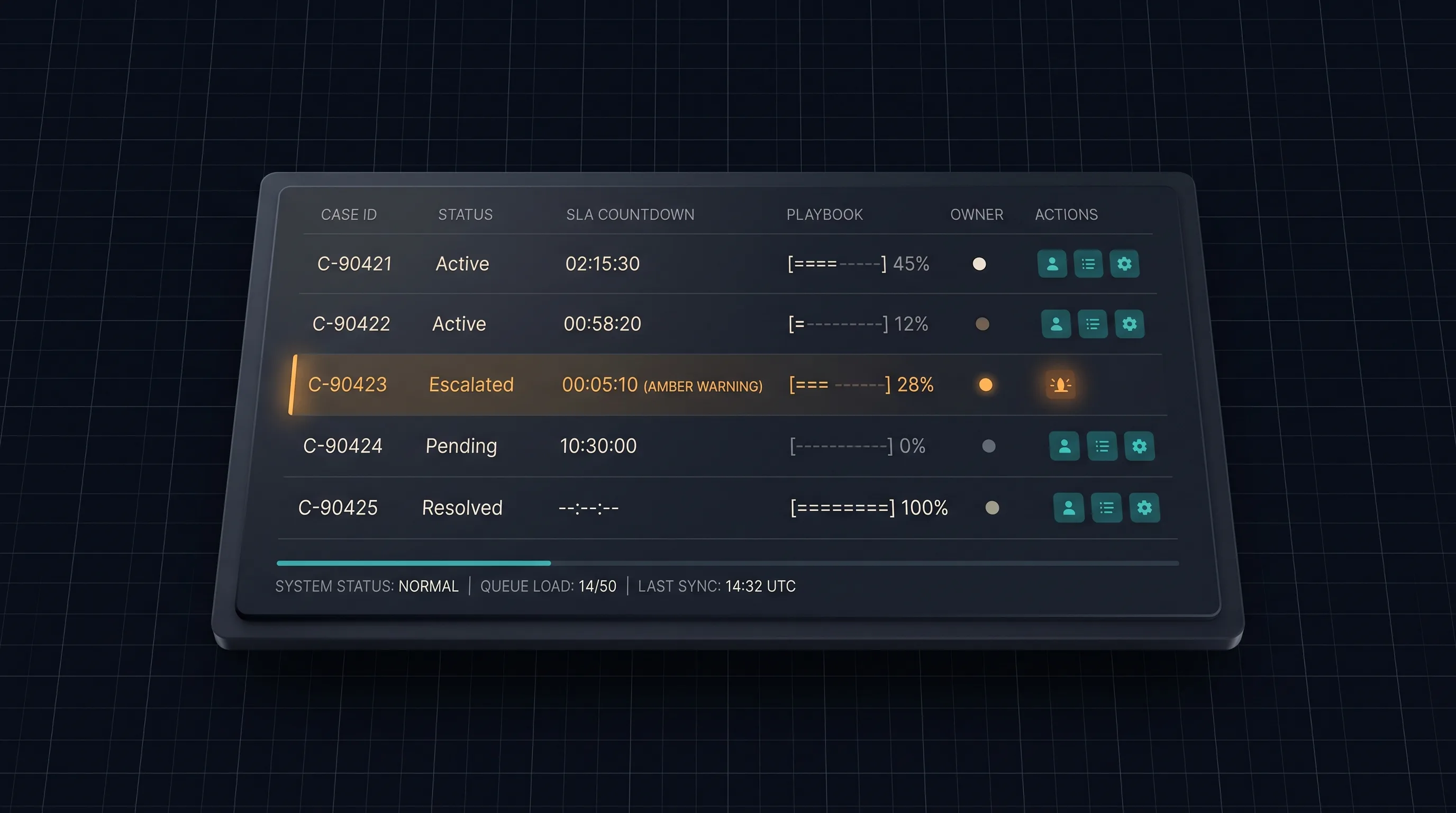
Every exception becomes a typed case: category, shipment, customer impact, owner, SLA clock, and a state machine from detected to resolved. Detection feeds in from carrier events, TMS status codes, and — realistically — parsed emails. The queue answers the three questions an ops lead asks all day: what’s burning, who’s on it, and what’s about to breach. Nothing resolves by falling off the bottom of an inbox — a case is either closed with an outcome or visibly still open.
Playbooks, written by the team
Each exception type carries a resolution playbook: the ordered steps a competent operator would take, with the branches that matter. Playbooks are editable content owned by the operations team — not code, not consulting deliverables — because the team’s veterans already know these procedures; the product’s job is to get them out of heads and into a form that survives turnover and scales to the new hire’s first week.
Automating the boring 80%
Inside a single resolution, most steps are mechanical: look up the carrier’s latest scan, pull the commercial invoice, draft the customer notification, prefill the rebooking form, chase a status. Automation owns those. The judgment calls — accept the reroute cost or wait, compensate the customer or hold, escalate to the carrier manager or let it ride — are deliberately human, presented with the gathered context and the playbook’s guidance. AI’s role is modest and useful: drafting communications from case facts and suggesting the likely exception category, with every suggestion editable and every draft sent by a person.
- Exception detected carrier event, status code, or parsed email
- Case created & categorized suggested type, human-confirmable
- Context gathered scans, documents, history — automated
- Judgment call reroute, compensate, escalate — human decision
- Mechanical steps execute drafts, forms, chases — automated
- Resolution & writeback audited update to TMS/ERP, human-verified
Integration reality
The design assumes the systems of record are old, half-documented, and immovable. Ingestion adapts to what exists: EDI batches, nightly exports, SOAP endpoints of a certain vintage, and email as a de facto integration surface. Writes back are treated with more respect than reads: every writeback to a TMS or ERP is previewed, attributed, and audit-logged, and the riskiest ones stay human-confirmed indefinitely. A tool that corrupts the system of record once is uninstalled forever; the concept would rather be slower than trusted less.
Prototype scope
Three exception types end-to-end — customs hold, missed pickup, address failure — with the queue, editable playbooks, communication drafting, and read-only integration to one TMS data feed. Writebacks stay manual in the prototype; earning them is a milestone, not a starting point. The measurement baseline comes first: two weeks of observing how the target exceptions are handled today, because “faster than before” is only a claim if “before” was actually measured — and because watching real resolutions is where the first honest playbooks come from.
Evaluation and open questions
- Time-to-resolution per exception type against a baseline measured before the tool
- Automation share: what fraction of playbook steps actually run without a human touch (design target, not a promise — some steps will resist automation and should)
- Queue coverage: share of real exceptions the detection layer catches versus those still arriving by surprise
- Open: whether playbook maintenance survives contact with a busy team, and where the compensation-decision threshold sits before ops leads want approval workflows on top