Personal finance
Personal Finance Scenario Planner
Model life's big what-ifs — move city, change job, buy versus rent — on assumptions you can see and edit. Educational modeling, never financial advice.
The question it answers
“What actually happens to my finances if I move to a cheaper city on a lower salary?” “If we buy instead of rent, where are we in year ten — and in the bad year?” People make these decisions on gut feel and one-off spreadsheets, because the tools that exist either oversimplify to a single magic number or bury the model where it can’t be questioned. The concept is a planner whose entire personality is showing its work.
Assumptions are the interface
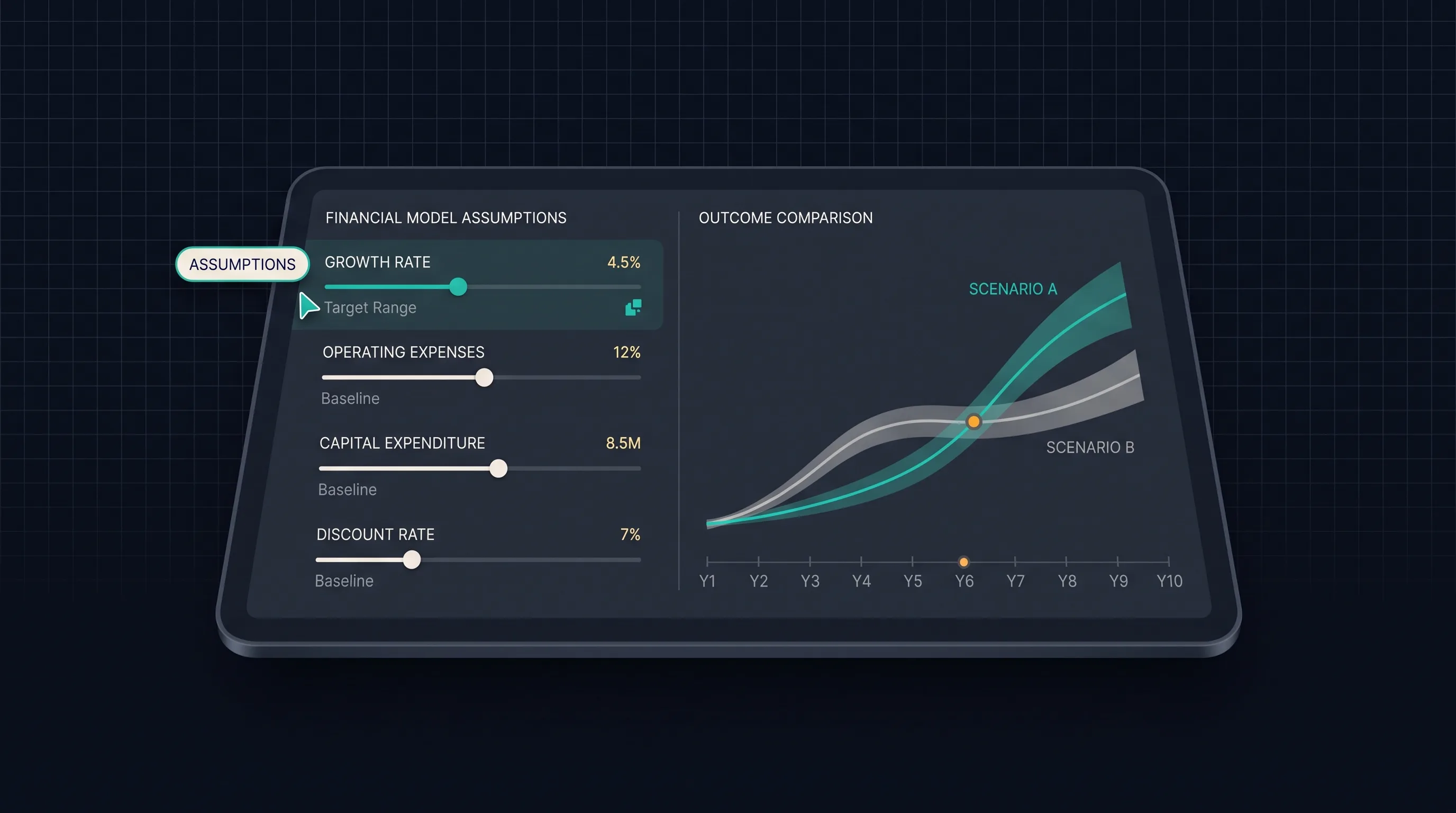
Every scenario is a stack of visible assumptions: salary growth, rent inflation, interest rates, maintenance costs, moving costs, tax treatment. Each one displays its provenance — a labeled default, or the user’s own edit — and each one is a control, not a footnote. Change the interest-rate assumption and watch the buy-versus-rent curves recompute in place. A sensitivity view ranks which assumptions actually move the outcome, because half the anxiety in these decisions comes from arguing about inputs that barely matter.
Ranges, not false precision
Outcomes render as ranges under stated variation, never as a single confident number. A tool that says “you will have €340,217” is lying with decimals; one that says “under these assumptions, likely between X and Y, and here is which assumption dominates” is teaching. The product’s credibility rests on refusing precision it doesn’t have.
The hard line: not financial advice
This must be explicit, in the copy and in the product: the planner is an educational modeling tool, not financial advice. It never recommends a product, a mortgage, an investment, or a decision. It has no affiliate relationships to protect and none are planned — recommendation revenue would rot the tool’s only asset, which is neutrality. The output of every scenario is understanding of consequences under stated assumptions; the decision, and any professional advice around it, belongs to the user.
Where AI fits — mechanics only
The AI’s job is narrow: explain the model in plain language. “Why does the buy scenario fall behind in year six?” gets an answer grounded in the model’s own arithmetic — the maintenance assumption compounding against the rent-inflation assumption — with links to the exact inputs involved. The AI never says “you should,” never suggests products, and its explanations are constrained to the computed scenario, so it cannot editorialize beyond what the numbers on screen already show. If a question exceeds the model’s scope, the honest answer is “this model doesn’t cover that.”
Prototype scope and evaluation
A credible prototype is two scenario templates — buy-versus-rent and city-move — with the assumptions panel, sensitivity view, and constrained explanation layer. Evaluation is a comprehension test, not an engagement metric: after twenty minutes with the tool, can users correctly restate the three assumptions that most drive their outcome (target hypothesis: most can, unaided)? And an integrity audit: across a sampled set of AI explanations, zero statements that recommend an action or product, zero claims not traceable to the on-screen model.