Healthcare documentation
Clinical Document Navigator
Find the right passage in thousands of pages of patient documents — located by AI, cited to the source, verified by a person, every time.

Product thesis
A patient’s paper trail is long: referral letters, discharge summaries, lab reports, imaging correspondence, decades of scanned faxes. The people who work with it — admissions coordinators, medical secretaries, case managers, clinicians preparing a consult — spend real time hunting for a passage they know exists. The interesting product is not “medical AI”. It is a navigation layer for documents that were never designed to be navigated: it finds, organizes, and cross-references, while the reading and every judgment stay with the person accountable for them.
What this deliberately is not
The system answers “where is it?” and “what refers to what?” — never “what does it mean?”. No diagnostic suggestions, no clinical recommendations, no summaries that stand in for reading the source. This is a product decision and a regulatory posture in one: the concept is scoped to remain a documentation tool, with explicit guardrails against feature drift toward interpretation, because that drift changes what the product legally is.
Who it serves
- Admissions and referral coordination teams assembling complete records
- Medical secretaries and case managers preparing files for consults and transfers
- Clinicians who need the original passage, not a paraphrase of it
- Clinical coding, quality, and audit teams who work backwards through histories
The problem, concretely
- A single complex patient can mean hundreds to thousands of pages across systems
- Much of it is scanned or faxed — unsearchable without disciplined OCR
- “When was this medication first mentioned?” means manual page-flipping today
- Cross-checking a value in a discharge summary against the original lab report is tedious enough that it often doesn’t happen
- The cost of missing a document is asymmetric: minutes saved against consequences that land on a patient or in an audit
Product strategy
- Locate, never interpret. Every capability is a pointer into the source material. The moment the system starts explaining what a finding means, it has left its lane.
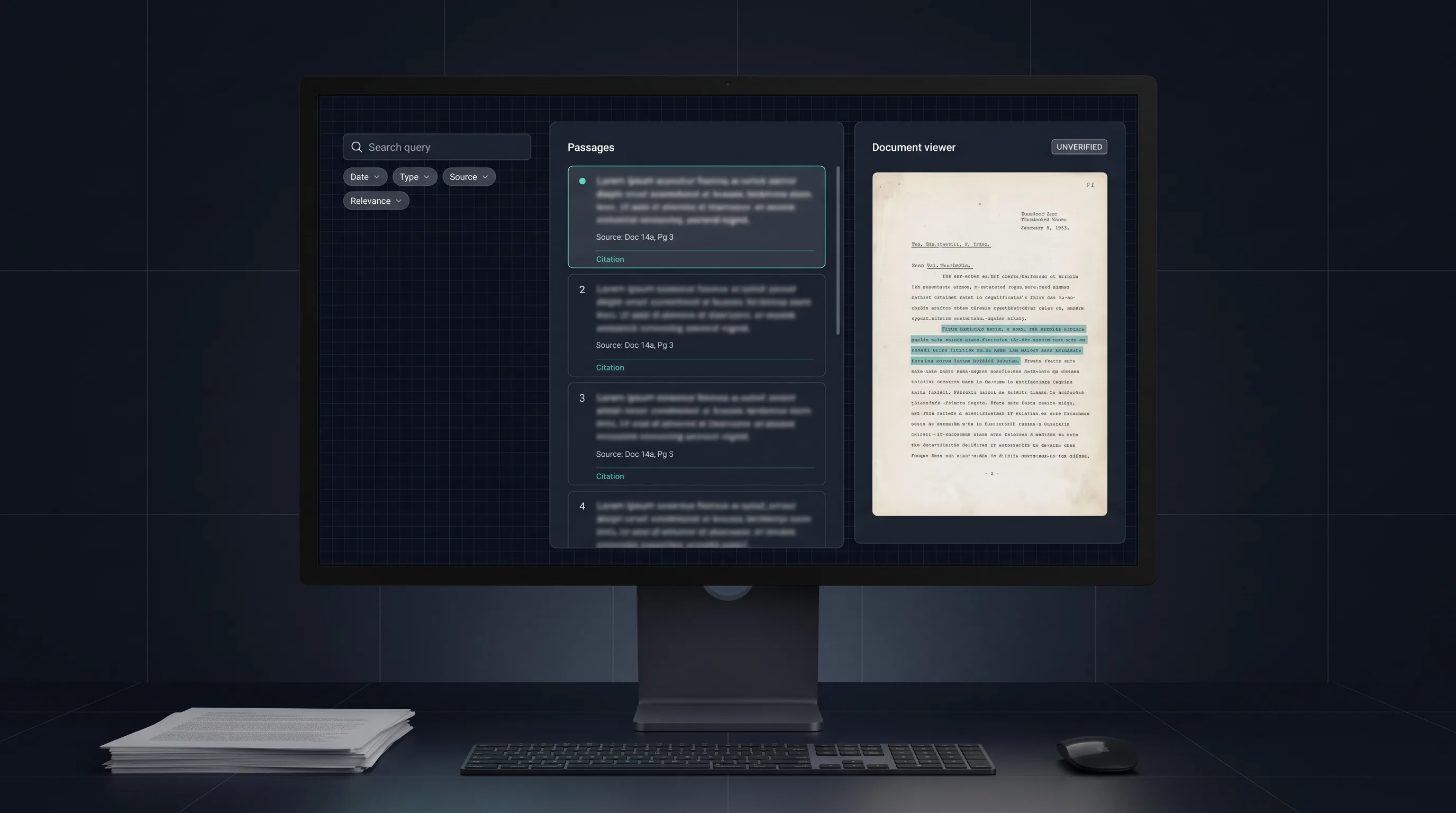
- Citation or nothing. Every result is a highlighted passage in the original page, shown alongside the answer. If the system cannot point, it does not speak.
- Verification is the workflow, not a checkbox. Results stay marked unverified until a person has opened the source. Working sets and exports only complete on verified items.
- Data protection as architecture. Health data handling is designed in from the first line — residency, isolation, and auditability are structural, not settings.
Core user journey
- Documents ingested OCR, typing, dating, de-duplication
- Staff asks or filters “last mention of anticoagulants”
- Passages retrieved ranked, each citing its source page
- Reader verifies in source side-by-side viewer
- Item added to working set verified status recorded
- Handoff or export audit trail attached
Major features
- Ingestion pipeline: OCR for scans and faxes, document typing (referral, discharge, lab), date extraction, duplicate detection — with per-document quality scores surfaced, not hidden
- Timeline view: the entire document set ordered by clinical date, not upload date
- Passage-level retrieval with the source highlight one glance away
- Cross-reference panel: the same medication, allergy, or finding traced across documents
- Working sets: assemble the exact pages needed for a consult, transfer, or audit task
- Coverage indicator: which documents the current query searched — and which it could not read, so a gap is visible instead of silent
Where AI fits — and the line it never crosses
Retrieval is the core: passage search over a per-patient index, document classification, entity linking so that one substance or finding connects across letters written years apart. Extraction fills document metadata — type, date, author organization — with per-field confidence.
The line: no interpretation, no clinical inference, no answer without a citation. Low- confidence OCR is flagged, never silently corrected, because a plausible wrong word in a lab value is worse than a visible gap. And the system never ranks by clinical importance — that would be a judgment in disguise. It ranks by textual relevance and says so.
Data protection is the architecture
Health data is special-category data under GDPR Article 9, and this concept treats that as the starting constraint rather than a compliance afterthought:
- EU data residency end to end, including model inference inside the same boundary
- Tenant isolation with encryption at rest and in transit; no training on customer data
- Role-based access mirroring the organization’s own authorization model — the tool never widens who can see a document
- Append-only audit trail of every search, view, and export, serving both accountability duties and the organization’s own oversight
- Retention and deletion aligned to the customer’s medical-records obligations
- A data protection impact assessment scoped before any pilot touches real records
System overview
- Web application built around a fast document viewer — the viewer is the product’s floor
- Ingestion pipeline feeding a typed document store and per-patient search index
- Retrieval and entity-linking services with confidence surfaced per result
- Append-only audit log as a first-class subsystem
- Import from archive and document-management systems; exports back with provenance
Accessibility considerations
This is all-day software for desk staff: full keyboard operation, screen-reader-compatible results and viewer, high-contrast reading mode, and no interaction that depends on hover or color alone. Structured results make assistive output natural rather than retrofitted.
Prototype scope
Narrow and synthetic: one task (assembling a referral packet), one document mix, and a corpus of entirely synthetic patient records — no real patient data before the compliance groundwork is real. The hypothesis is behavioral: does citation-first navigation beat the current PDF-reader-and-Ctrl-F workflow by enough to change a working habit?
Evaluation plan
- Retrieval recall on a labeled synthetic corpus of known-item queries (target hypothesis: high enough that staff stop double-searching manually — measured, then argued about)
- Time-to-verified-passage against a manual baseline on the same tasks
- Zero tolerance for uncited assertions anywhere in the product surface
- Complacency check: do users keep opening sources after week four, or start trusting the snippet? The design goal is that verification stays cheaper than doubt
- OCR quality floor: measured error rates on aged fax stock, because that is the real input
Risks and open questions
- Regulatory boundary: features that drift toward interpretation could reclassify the product under medical-device rules; the roadmap needs a standing guardrail review
- The blank-spot problem: a retrieval miss can be worse than no tool, because the tool creates confidence — coverage indicators must make “not searched” impossible to miss
- Decades-old scans put a hard ceiling on recall; honesty about that ceiling is a feature
- Integration gravity: value depends on sitting inside hospital archive systems, and healthcare procurement moves in years, not sprints
Delivery phases
- Discovery with coordination and secretariat teams; corpus design and query taxonomy
- Ingestion and retrieval prototype on synthetic records, measured against the evaluation plan
- Verification workflow, audit trail, and the compliance groundwork (DPIA, processing agreements)
- Pilot integration with one archive system under a controlled scope, then hardening