Hospitality operations
Restaurant Operations Copilot
A shift manager's companion for independent restaurant groups — prep, ordering, handovers, and checks that survive a loud kitchen.
The experiment
Independent restaurant groups — three to fifteen sites, no ops department — run on the gut of veteran shift managers. The gut decides how much to prep, what to order before the Friday deadline, and what the next shift needs to know. The gut is genuinely good. It is also unrecorded, untransferable, and it walks out the door when the manager does.
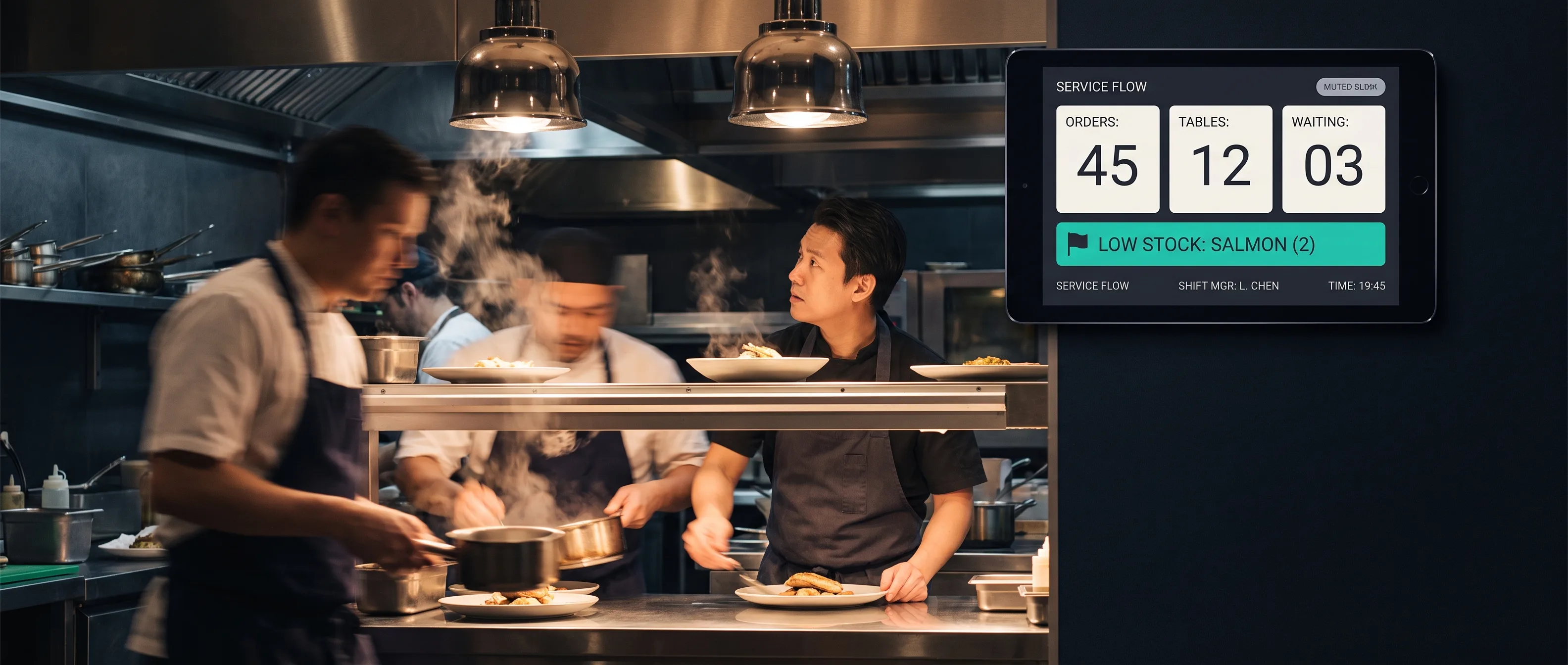
The experiment: can ordering and prep suggestions derived from sales patterns beat that gut — measured honestly, decision by decision? And the quieter question underneath it: will a shift manager in a loud, wet, forty-degree kitchen consult a screen at all?
Who it serves
- Independent restaurant groups of three to fifteen locations
- Shift managers and kitchen leads who own prep, ordering, and handover
- Owners and ops leads who see waste and stockouts only in aggregate, weeks later
A shift manager’s Friday
Prep quantities get set at 15:00 from memory of last Friday. The produce order is due mid-service, decided in ninety seconds between tickets. The handover to tomorrow’s manager is three sentences shouted across the pass, or a note on a receipt roll. Temperature checks that should happen at fixed times get batch-signed at close — a known failure mode across the industry, with real food-safety consequences. None of this is negligence. It is what the tools of the trade — a clipboard, a group chat, a POS report nobody opens — make possible.
Product shape
- Glanceable or nothing. Every interaction is designed for under ten seconds, one thumb, big type, wet hands. No feeds, no dashboards during service.
- Suggest with reasons, override with one tap. An ordering suggestion shows its basis — the last four Fridays, the weather, tomorrow’s reservations. The manager’s override is a single tap, and overrides are treated as signal, not as user error.
- Offline-tolerant by design. Kitchen connectivity is bad in exactly the spots where the work happens. Everything reads and writes locally and reconciles later.
- Make the honest path the fast path. Checks are time-stamped at the moment of completion. The tool cannot force honesty — it can only make doing the check now easier than batch-signing at close, and that is the design bar.
One shift, end to end
- Prep list proposed from sales patterns and reservations
- Manager adjusts, confirms one-tap overrides, logged as signal
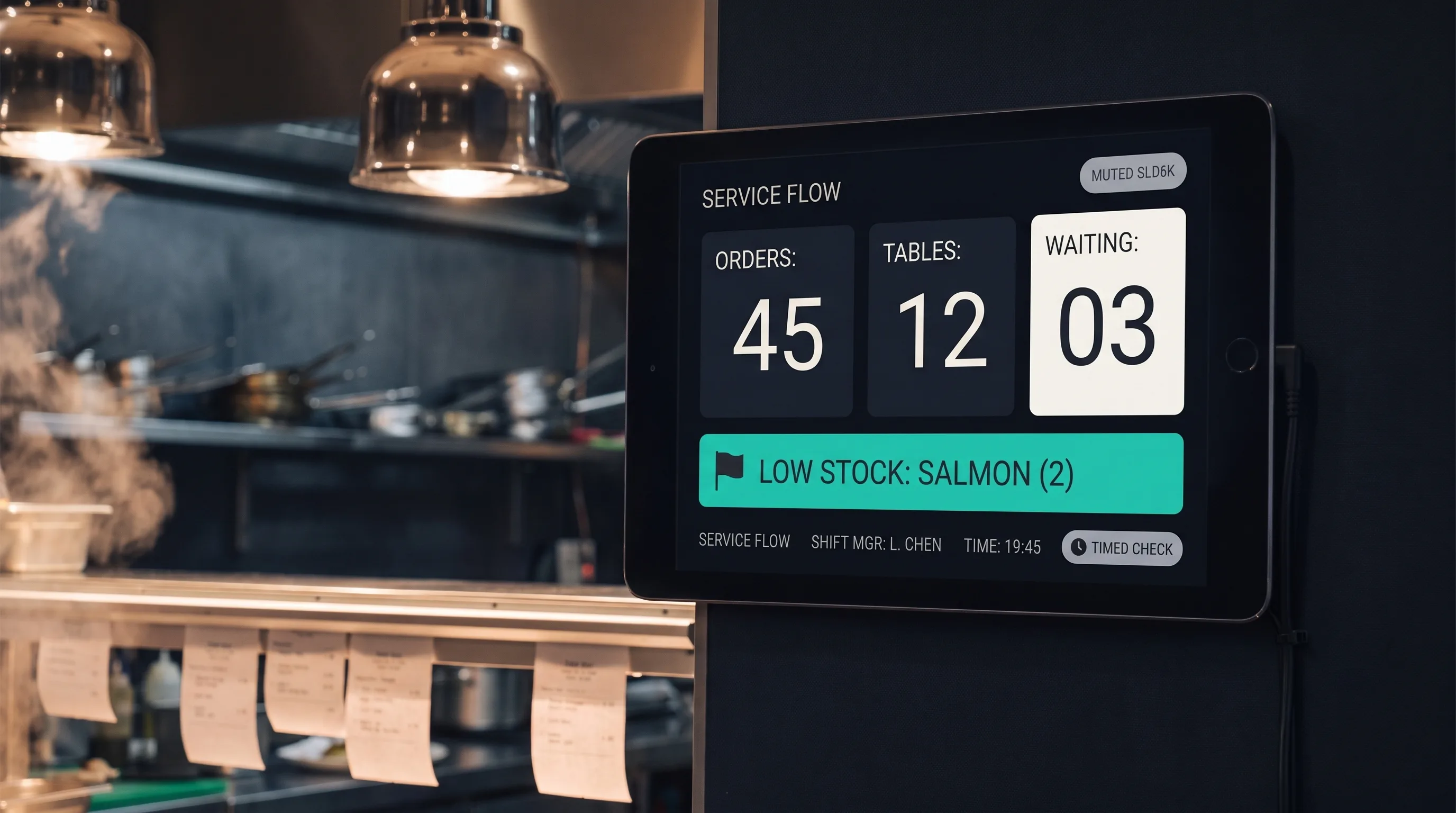
- Service mode glanceable counts, low-stock flags
- Checks prompted at their times temp and HACCP-style, stamped on completion
- Handover drafted from the shift's actual events
- Order confirmed by the manager suggestion and gut both recorded
Major features
- Forecast-driven prep lists per station, adjusted in seconds
- Ordering suggestions with visible reasoning and a one-tap override
- Handover notes drafted from what actually happened — 86’d items, equipment issues, no-shows — then edited and accepted by the incoming manager
- HACCP-style check scheduling with temperature and photo capture at the moment of the check
- Ten-second waste and stockout logging, because the scoreboard depends on it
- Owner view across sites: patterns and totals, deliberately not a surveillance feed
Built for a loud kitchen
The environment is the hardest constraint and it shaped the platform choices. Voice input is deliberately absent — a kitchen at full service defeats speech recognition and dignity alike. Instead: a wall-tablet service board readable from two meters, phone interactions sized for one greasy thumb, haptic and color-state confirmation rather than sound, and an offline-first store so a dead access point during the rush costs nothing. The cheap Android tablet zip-tied above the pass is a first-class citizen, not an afterthought.
Where AI fits — and where the gut still wins
Forecasting is the core: per-item demand from POS history, day-of-week structure, weather, reservations, and local events. Language models draft the handover note from the shift’s structured event log — a summary of things that happened, not opinions about people.
The limits are explicit. No auto-ordering: every order is confirmed by a person, because a bad automated order on a holiday weekend is how trust dies. No staff performance scoring — a stated non-goal, revisited every time a feature brushes against it. And the gut keeps winning on everything the data cannot see: the road closure, the local festival that doesn’t hit any calendar API, the regular who books for four and brings eleven. That is exactly why overrides are first-class input rather than noise to be trained away.
Measuring honestly
The scoreboard is the experiment’s spine, and it cuts both ways. For every decision where the suggestion and the manager’s final call differed, the outcome — waste, stockout, neither — is logged against both. The manager sees the same scoreboard the product team does, including the weeks the gut wins.
- Suggestion acceptance rate over time, per category
- Counterfactual comparison on divergent decisions: whose number would have been better?
- Check completion timing: are checks happening at their scheduled moments, or migrating back toward close-of-shift batches?
- Handover usefulness: how much does the incoming manager edit, and does the paper note die?
- Working hypothesis, stated up front: suggestions beat the gut on high-volume staples and lose on specials and events — and the product should say so per category
Prototype scope
One design-partner group, one site, and ordering only — restricted to the top staple SKUs where the data is densest. Phase one runs in shadow mode: suggestions are generated and logged but never shown, so the scoreboard has a baseline before anyone’s behavior changes. Prep lists and checks follow only if the ordering loop earns its place on the counter.
Risks and open questions
- Trust asymmetry: one bad Saturday suggestion outweighs a month of quiet wins; per-category rollout and the visible scoreboard are the mitigations, not solutions
- POS data quality varies wildly between systems; the connector work is the real cost floor
- Honesty limits: if the fast path stops being the honest path anywhere in the checks flow, batch-signing returns silently — this needs field observation, not telemetry alone
- Scale economics: forecast tuning per site must stay near-zero-touch for the concept to make sense at independent-group prices
- Scope-creep pressure toward staff monitoring will come from buyers; the non-goal has to survive contact with the sales pipeline
Delivery phases
- Shift shadowing at partner sites; POS export audit and event-log design
- Shadow-mode forecasting with the scoreboard measured against actual orders
- Live suggestions on staples at one site; service board and offline hardening
- Handovers and checks; rollout across the partner group, category by category