Consumer travel
Multilingual Travel Companion
Situational language help for travelers — the pharmacy, the delayed train, the allergy — with honest offline tiers instead of another translation app.

Product thesis
Machine translation is good enough that “translate this sentence” is no longer an interesting product. Travelers still get stuck, and they get stuck in situations: a pharmacy counter where the useful question is not “how do I say ibuprofen” but “what is this pharmacist allowed to sell me, and what will they ask next”; a platform announcement that just cancelled a connection; a dinner order where a mistranslated allergy is not an inconvenience. This prototype treats language as one ingredient of situational competence. The unit of design is the situation — its goal, its typical script, its failure modes — not the sentence.
Explicitly not a translator clone
The bar for this concept is simple: if a screen could be replaced by a general-purpose translation app without loss, the screen is wrong. Translation is a commodity layer underneath. What sits on top is preparation (what to expect), phrasing (what to say and how to say it appropriately), and comprehension (what the reply actually meant, including the parts a literal translation drops). The prototype exists to test whether that layer is a product or just a feature.
Who it serves
- Independent travelers in countries where they don’t read the script, not just the language
- People managing constraints that raise the stakes — allergies, medication, mobility needs
- Occasional business travelers who need transactional competence, not fluency
The situation model
The content spine is a library of situation packs: pharmacy, train disruption, restaurant with dietary constraints, taxi negotiation, hotel problems, minor medical care, police or lost-property encounters. Each pack defines the goal, the roles, the likely script with branches, the phrases worth saying well, and the answers to expect back. Packs are authored and reviewed per country, because a pharmacy in Japan and a pharmacy in Portugal are different institutions that happen to share a name.
Core journey
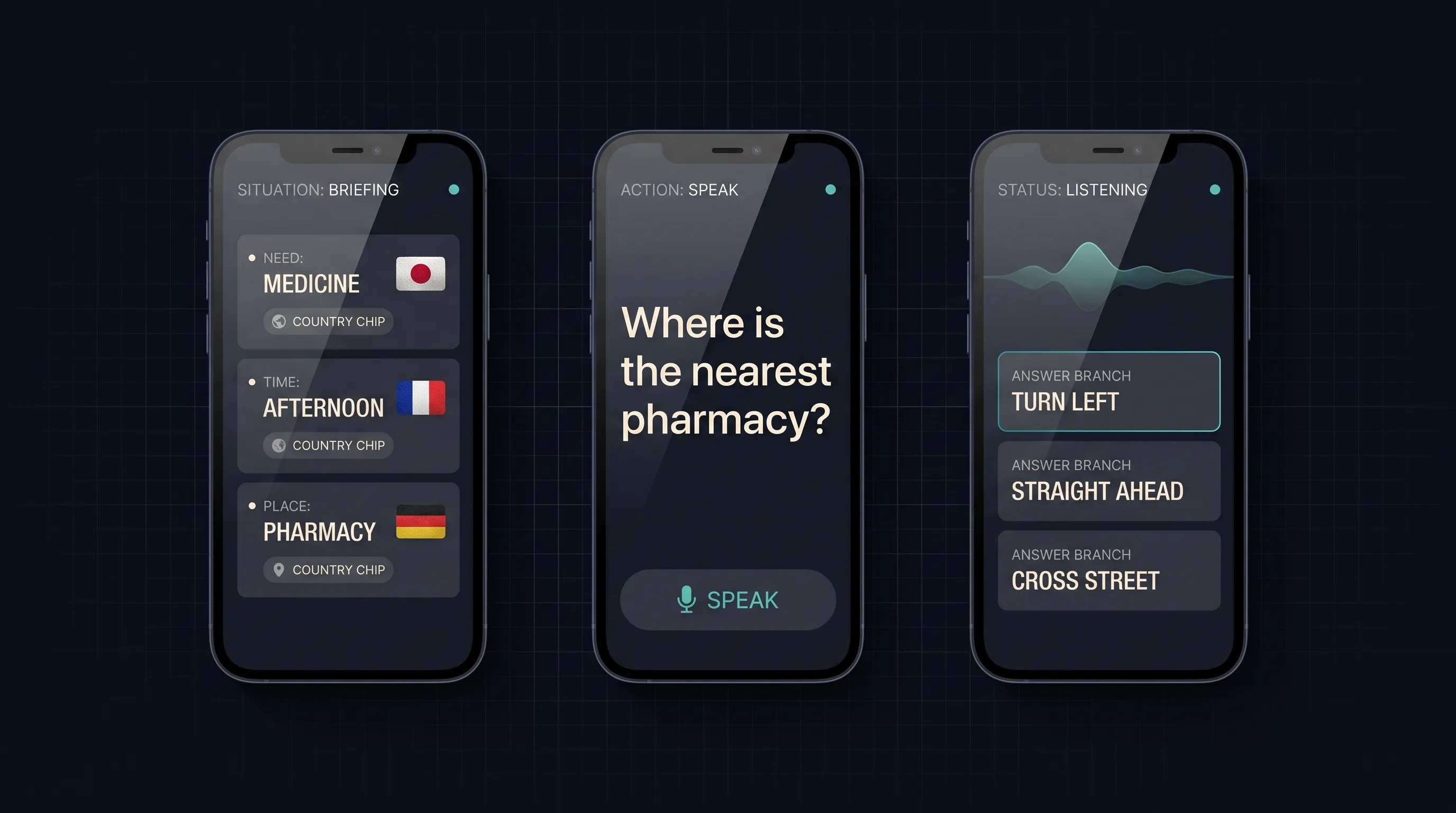
- Pick the situation 'Ordering with an allergy' — set once per trip
- Companion briefs you how allergies are handled locally
- Show or speak the ask phrased for the kitchen, not word-for-word
- Listen mode waiter's reply mapped to the expected branches
- Traveler decides order, clarify, or walk away
The amber step matters. In allergy and medical situations the companion never renders a verdict (“this dish is safe”); it renders what was said, how confident the understanding is, and what a cautious person would confirm next. The decision stays with the traveler.
The latency budget
Conversation dies at the pause. The design budget for the live-help loop is 1.5 seconds from end of the other person’s utterance to usable output — displayed text first, spoken audio a beat later. That budget forces the architecture: speech recognition streams incrementally, situation packs pre-load the expected reply branches so classification is matching rather than open-ended generation, and anything that needs a server round-trip is staged so the traveler sees partial understanding immediately. Where the budget can’t be met — long free-form replies on a weak connection — the interface degrades to “show them the screen” mode deliberately rather than leaving a person standing in silence.
Offline degradation tiers
Travel is the worst connectivity environment a consumer app can have: roaming disabled, metro tunnels, rural lines, dead spots exactly where help is needed. Instead of one “offline mode” the prototype defines three explicit tiers, and every feature declares which tier it belongs to:
- Tier 0 — no signal. Downloaded situation packs work fully: briefings, phrase cards with recorded audio, expected-reply cards, and on-device recognition of short replies within a pack’s branches. Camera reading of common signage from the offline sign library. Nothing greys out without saying what still works.
- Tier 1 — poor or metered. Text-first exchange with compact models; audio synthesis deferred; menu photos processed at reduced resolution with a visible quality note.
- Tier 2 — good connection. Full conversational mode, open-ended listening beyond the pack’s script, and richer camera understanding of full menus and documents.
The tier indicator is always visible. The hypothesis is that travelers tolerate reduced capability far better than unpredictable capability.
Menus, signs, and the camera
Camera understanding is scoped to two jobs: what does this say and what does this mean here. A menu photo returns dishes annotated against the traveler’s declared constraints — flagged, not filtered, with the original text preserved so a waiter can point. A sign or ticket-machine photo returns the operative instruction (“validate before boarding”) rather than a full translation of boilerplate. Both jobs run at Tier 2 quality online and degrade to the offline sign library and pack vocabulary at Tier 0.
Cultural context is content, not inference
The riskiest failure mode is confident cultural wrongness: telling a traveler that tipping is expected where it is mildly insulting, or that a pharmacist can dispense something that requires a prescription locally. The prototype’s position is that cultural and regulatory context is authored, reviewed content — written per country with local reviewers, and versioned — not something a model infers at runtime. The model phrases and interprets; the facts about how the situation works come from the pack. Where a pack has no answer, the companion says so instead of improvising one.
Where AI fits — and its limits
AI does the work only AI can do: streaming speech recognition, register-appropriate phrasing, mapping messy replies onto a pack’s expected branches, and reading photographed text in context. It is kept away from safety verdicts (allergy safety, medication equivalence, legal advice), from cultural claims not backed by pack content, and from inventing branches a pack doesn’t cover — an honest “I didn’t catch that, show them this card” beats a fluent guess in every situation this product cares about.
Prototype scope
As an interactive prototype, the build is deliberately narrow: two country packs, five situations each, one language pair per pack, running on real devices with airplane mode as a first-class test state. The question being tested is behavioral: in a staged situation, does a traveler using the companion reach their goal faster and with more confidence than one using a stock translation app — and does the situational layer, not the translation, account for the difference.
Evaluation plan
- Staged-situation trials: task completion and time-to-goal vs. a translation-app control group
- Latency measurement against the 1.5-second budget across connectivity conditions
- Tier 0 audit: every advertised offline capability exercised with radios physically off
- Comprehension checks: did travelers correctly understand replies, measured against transcripts
- Cultural-content review: zero unreviewed country claims shipped in any pack
Risks and open questions
- Content economics: hand-reviewed situation packs per country are expensive; the pack count that makes the product feel complete is unknown
- Social friction: will people actually hold up a phone mid-conversation, or does the product need to lean harder into pre-briefing and cards
- Liability boundary: allergy phrasing sits close to medical advice; where the “confirm with a human” line goes needs review per market
- On-device model quality for low-resource languages may force the offline tier to be cards-only in some pairs — honest, but less impressive
Expansion possibilities
If the situation model proves out, packs become the platform: accessibility-focused packs for travelers with disabilities, business-travel packs, and a shared pack format that local experts could author under review. Each is a content decision before it is a feature.