Home & family
Family Logistics Planner
Shared calendars, tasks, and handoffs built for two-household and caregiver realities — deliberately predictable, deliberately AI-free.
The family that apps assume doesn’t exist
Shared-calendar products assume one household, two cooperative adults, and goodwill. Real coordination is often harder: separated parents who co-parent well but don’t share a home, blended families with four adults and asymmetric custody weeks, siblings coordinating who drives their mother to appointments. These are logistics-heavy, trust-uneven arrangements — and the current tooling is a group chat, two incompatible calendars, and recurring arguments about who knew what.
The handoff is the atom
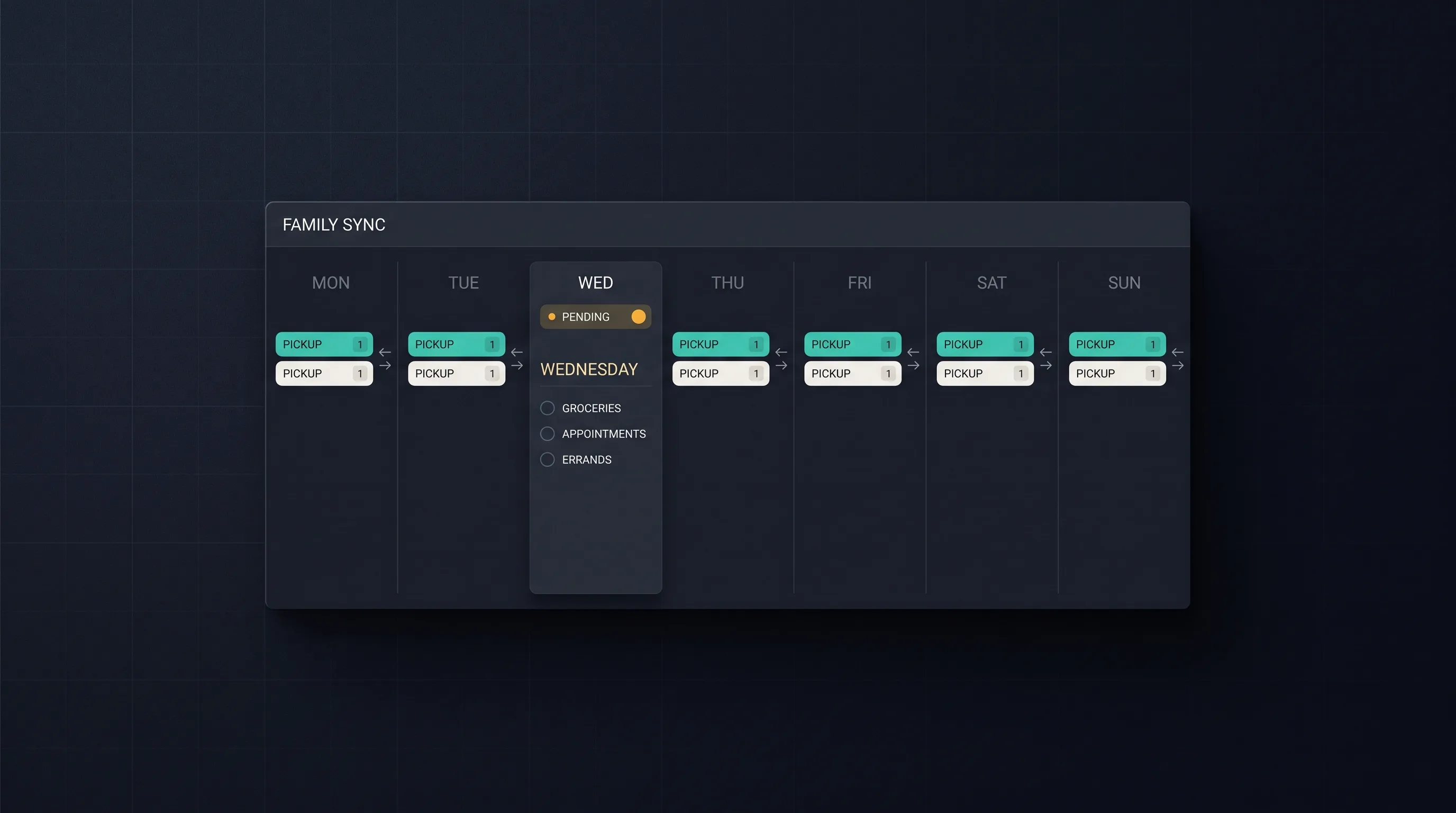
The central object isn’t an event but a handoff: a child, a dependent, or a responsibility passing from one adult to another at a time and place. Handoffs have what calendar entries lack — an explicit from and to, required acknowledgment, and the attached context that prevents the 17:40 phone call: the gym bag, the antibiotics, the form that needs signing. A week renders as a chain of custody for family life; an unacknowledged handoff is visible days ahead, while it’s still a plan and not a crisis.
Why version one has no AI
This is a deliberate stance, not a gap. Coordination between co-parents runs on predictability: the same information, rendered the same way, to both sides, every time. A model that summarizes, prioritizes, or “smartly” suggests introduces variance exactly where variance is expensive — and in a low-trust arrangement, “the app told me something different” is a new argument, not a saved one. Reminders fire on rules everyone can read. Schedules repeat exactly as written. If AI ever enters, it enters at the edges (parsing a school’s PDF newsletter into proposed events, clearly marked as proposals) — never between two parents and the facts.
Privacy between family members
Most products treat the family as one trust boundary. Here the boundaries run through the middle of the data, and the design starts there:
- Each adult sees shared logistics, never the other household’s private calendar; “busy” is an acceptable answer
- Children’s information is scoped to the adults responsible for them, per child — relevant in blended families
- A caregiver invited for one responsibility sees that responsibility only
- The record of acknowledgments is append-only and equally visible to both sides — symmetric memory, so the app can’t be enlisted as anyone’s witness selectively
Prototype scope
Two-household co-parenting as the first configuration: shared children, custody rhythm, handoffs with acknowledgment, and the mutual-visibility model. Caregiver circles reuse the same primitives with different labels — that reuse is itself a hypothesis to validate, not assume.
Evaluation plan
- Does the acknowledged-handoff loop survive contact with real weeks, or decay into another ignored notification stream? (Acknowledgment rate over eight weeks)
- Reported “who-knew-what” conflicts before and after adoption, via structured interviews with pilot families
- Symmetry check: do both sides of a two-household setup remain active, or does one parent become the unpaid operator of the system?
- Willingness to pay, tested honestly: this is a product families keep for years or drop in a month, and pricing follows retention, not the reverse