Creator economy
Creator Production Planner
A production pipeline for serious independent creators — and an experiment in whether structure sustains creative momentum or quietly kills it.
The experiment question
Somewhere between hobbyist and media company sits the independent creator publishing weekly: one or two people, three platforms, a backlog of ideas, and a production process held together by notes apps and dread. Project-management tools exist, but creators abandon them at remarkable rates — and the interesting hypothesis is that this isn’t a discipline problem. Production structure may genuinely conflict with how creative momentum works. This experiment tries to find the line: how much pipeline helps, and where does it start to hurt?
Who this is for
Not aspiring creators — the tooling market already over-serves the dream. This is for people with an existing publishing rhythm and real stakes in keeping it: the podcaster with sponsors, the YouTuber whose income notices a missed week, the newsletter writer juggling three formats. Their problem isn’t motivation; it’s that they run a small production company inside one person’s head.
Shape of the build
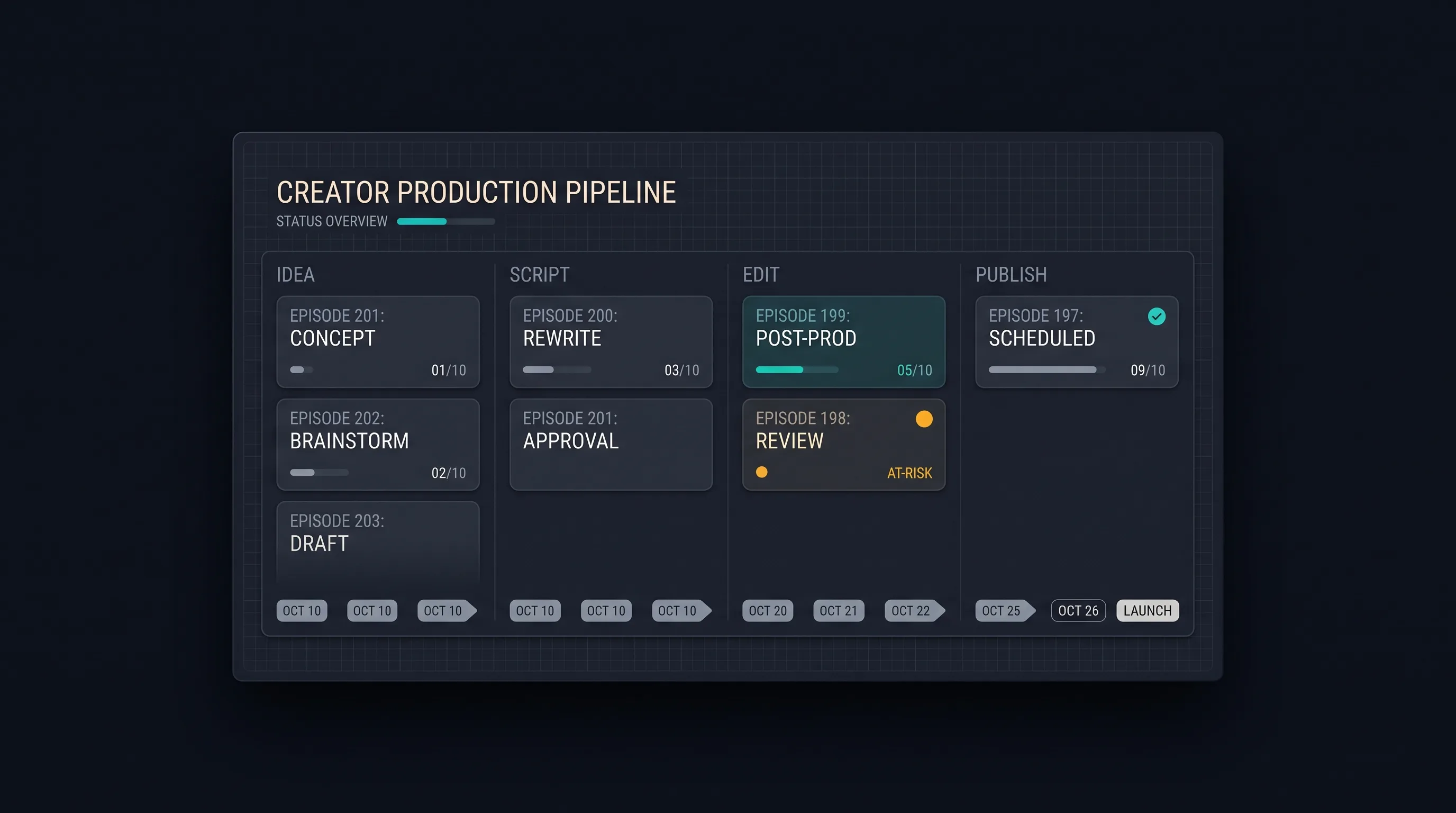
- A pipeline with honest stages — idea, committed, scripted, in edit, scheduled, published — where “idea” is a cheap, guilt-free holding pen, not a backlog that stares
- A calendar that plans backwards from publish dates: commit to a slot, and the edit and script deadlines derive automatically from that creator’s measured pace
- Per-episode workspaces holding the script, assets, versions, and platform checklist
- Deliberately absent: velocity charts, burndown graphs, and any dashboard that frames a creative week as underperformance
The momentum question, made testable
The experiment instruments the thing creators report but tools ignore: whether the system pulls work forward or becomes another audience to disappoint. Concretely under test — does backward planning from publish dates reduce missed slots compared with the creator’s baseline? Do “cheap idea capture” users convert more ideas into published work, or just hoard? And the kill signal: if creators log in mainly to update statuses rather than to decide what to do next, the tool is administration, and administration loses to a whiteboard.
Integrations honesty
Creator-platform APIs are brittle, rate-limited, occasionally revoked, and versioned at the platform’s convenience — designing as if they were stable infrastructure is how this category of product dies. The planner treats every integration as optional enrichment: scheduling data and publish confirmations flow in when a connection works, and when it breaks, the pipeline degrades to manual confirmation with a visible “last synced” timestamp rather than silently showing stale truth. No feature that matters depends on a third-party API staying generous.
Evaluation plan
- Missed-slot rate against each creator’s own three-month baseline — the only comparison that’s fair
- Idea-to-published conversion, tracked per stage to find where work actually dies
- Session shape: ratio of planning actions to status-updating actions, as the administration early-warning signal
- Exit interviews with every churned pilot user; in this category, the reasons people leave are the experiment’s most valuable output